
This is the spectrum of colours. All humans can see it. However, we do not all see it the same way. Reading as you are the English words of this article, then its likely that you automatically divide this spectrum as: Violet, Indigo, Blue, Green, Yellow, Orange, and Red. Each colour clearly ends and is divided in another. This is a truth of the universe is it not?
Well, actually it isn’t.
If you were Welsh for example, what we call “blue”, as well a bit of “green” and “gray” would all fall under the colour glas. If you spoke the Ibo language of Nigeria, you would categorize under ojii what we English-speakers would call “black”, “brown”, and “gray.” Why is this so?
The truth is a little staggering to realize at first, but colours are not divinely designated, but rather culturally so. In our everyday lives we see objects that fall neatly into the categories of the spectrum we were given at
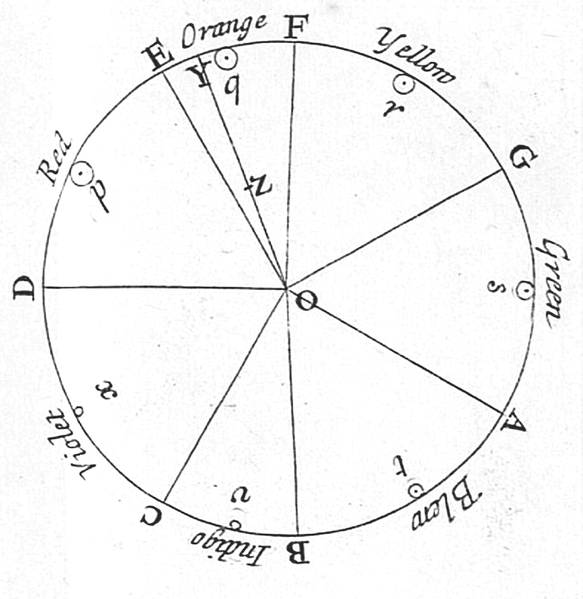
The spectrum of colours, music, and astral bodies as Newton outlined them in the 17th century.
birth. But take a look at the colour spectrum above. Why are the colours divided as they are? They all fade gradually into one another; there are no clear divisions. So why are cut as they are in our minds? Well, for us the 7 colour legacy comes from Isaac Newton. He discovered the spectrum that hid within white light with the aid of a prism, and divided those colours into 7 categories. Why? Simply because 7 was a significant number for Western thought: there are 7 musical notes, 7 days to a week, and there were then only 7 known objects in the solar system.
This goes to show that although the spectrum of colour is universal human constant, colours are not. Colours, in a sense, are not fundamentally true. They are simply frames, lenses through which we can interpret the spectrum. This is an important lesson that needs to be applied to a similar situation, the spectrum of human consciousness.
Consciousness
Like we see colours, every human is capable of experiencing a broad range of states of consciousness that go from alert, to dream-less sleep, to dream, to transcendental (if you believe the oriental texts). Here again we find the case of cultural divisions. Truly, what is the difference between, say, being awake and alert and dreaming? We obviously see a difference because we were born into pre-made categories to help us understand the various states of consciousness. But again, the spectrum gradually fades from one state to the next. Does a dream not feel real? How many times have we awoken expecting to find the stuff of our dreams around us?
It is inevitable to realize that, like colours, the spectrum of consciousness is a truth, but how it is viewed is culturally defined, and thus subject to change. This implies that what we see as normal behaviour is agreed upon social construct that has only culture as a basis. This also implies that, as David Lewis-Williams says:
“Bluntly put, madness is culturally defined; what counts as insanity in one society may be valued in another.” [1]
In example, think of the Norse or Viking societies, which valued violent behaviour in the functioning of its society in comparison to our own where violence is much less openly accepted.
In Nobel Prize winning Gerald Edelman’s view, there are two order of consciousness. Primary Consciousness is that of the animals that may have a sense of self and some memories, but that cannot use mental faculties of past and future to construct dynamic social personas, to predict and plan, or to communicate complex ideas based upon these. Higher-order consciousness is that of the humans. It allows us to be conscious of being conscious, to make us aware of our actions in temporal frames, to have social personas, and to have complex language.
It is becoming a more prevalent view that what separated Homo Sapiens from Homo Neanderthalensis was not our intelligence, but rather our consciousness. [2]We humans have the ability to experience more than one state of consciousness, the ability to remember dreams and trances and thus to construct the ideas of a spirit world, of life after death, of religion, and to communicate these ideas in forming complex social structures. The Neanderthals would not have understood this. They only understood the here and now, why should they bury food or precious item with their dead as the Sapiens did?
The ancients understood the power of these states and these distinctions, and they were the foundation for the most beautiful of human endeavours: art, philosophy, religion, etc. Throughout history shamanism, spiritual practice, vision questing, trances, all were important and widespread. Usually these acts informed the idea that we exist in a fleeting world that is impermanent.
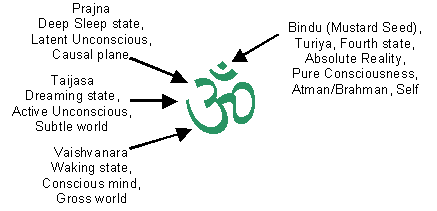
The Sanskrit Om symbol represents all states of consciousness as seen by the Indian cultures. Notice the difference between the Eastern and Western notions of consciousness.
Yet today in the West we are failing to see this. The knowledge of the ancients is forgotten, and we are obsessed with the alert problem solving state of consciousness, a fragment of the full spectrum. This gives us a myopic view. As the early American psychologist William James stated:
“Our normal waking consciousness . . . is but one special type of consciousness, whilst all about it, parted from it by the flimsiest of screens, there lie potential forms of consciousness entirely different. We may go through life without suspecting their existence; but apply the requisite stimulus and at a touch they are all there in all their completeness . . . No account of the universe in its totality can be final which leaves these other forms of consciousness quite disregarded.” [3]
To say that our current ‘account of the universe’ is incomplete would be a vast understatement. We live today in a world that discredits dreams as simple neuron misfiring, that belittles the mystical or spiritual experience that denies the yogic possibilities of transcendence. We are obsessed with the alert problem-solving end of the spectrum, and it is ironically causing us many problems.
The world is now driven by cold rationality and logic. This leads to exploitation of people and of our world to our own demise. It leads to a sense of emptiness, to loneliness and illusion of isolation from world and kin. It poses an existential question that our culture answers with materialism, consumerism, pollution, and disregard for life. For the first time in known history we have put our very own existence at risk by our myopic actions.
We may believe today that we are much better off than our nomadic ancestors were. However the truth remains that the indigenous way of life subsisted to our existence for tens of thousands of years with no cataclysmic problems (at least man-made). Indeed, in many contemporary shamanistic and indigenous cultures the people could be said to be much happier, and better off than we ‘civilized’ folks are. However the Western notion of development is also cultural. Is a large industrial output and constant economic activity truly better? The indigenous cultures work less, and are contented. They feel the connection to the Earth, to the spirits, to each other because they allow the states of consciousness that reveal these truths. It remains a constant that in these cultures that shamanism, visions, and revelations are valued. Those who still live in balance with our World will say that the problem with the West is that we have lost our connection to the spirit.
Widening our view
There exist in us all the emotional self, the spiritual self, and an innate sense of knowing of some of the greater truths of our existence. This may be hard to grasp from an exclusively alert state of consciousness, yet it is true. The idea of innate knowing, or gnosis, of transcendence, of a spirit world, of interconnectivity has always existed in human culture.
Alert consciousness rooted science tries to explain or put this down in the face of superior human logic, but they cannot. Even today, 70% of Americans believe in angels and demons. This can perhaps not be rationally explained, but there is more to logic in our existence. Of course logic is there, and powerful, but so is gnosis and spirituality. They express themselves in languages that are not always compatible, especially if we stubbornly insist on describing everything in logical empirical terms. If one insists on wearing red-lensed glasses, one will only see the colour red, despite the presence of the rest of the spectrum. Only open eyes can see. The same applies to consciousness.
We are in danger of going the way of the Neanderthals. We are trying to build the monument of our civilization on a single pillar. If indeed our flexibility along the consciousness spectrum is what separates us from the Neanderthals and the animals, then we should be embracing it with open arms.
In the West however, this is clearly not the case. The war on consciousness is manifest in the so-called “War of Drugs” which seeks to eliminate any substances that do not promote the standard alert-consciousness, substances that many of the balanced cultures of the world view as sacred medicine. Why this is the case is a subject that deserves its own forum. However, it can be safely stated that those who stand to gain the most from our current infatuation with a sliver of the consciousness spectrum, those who are at the top of financial ladder, do not want our eyes to open. See, the mad rush for money might make sense in the myopic alert view, but it does not when observed with the full flexibility of our vision and thought processes. In the religious or spiritual knowledge of impermanence why would we work so hard for material? If we are to believe the shamans and mystics and our own history, materialism and greed only make sense when viewed through the small lens of alert-consciousness of unbalance.
Why should dreams be somehow less real or tangible than the waking state? Who made these rules and why? This view is not necessarily wrong, but it is absolutely worth questioning, and regularly so. It is up to us to define our realities, and how we choose to perceive. For me one thing is clear however. That if experiencing a broad range of states of consciousness is what make us human, then by denying their existence and importance we are in effect denying a part of our humanity. We will never be able to be complete, to balance ourselves, and to move forward as a species until we embrace the full spectrum of our own existence.
 Julien Dupont