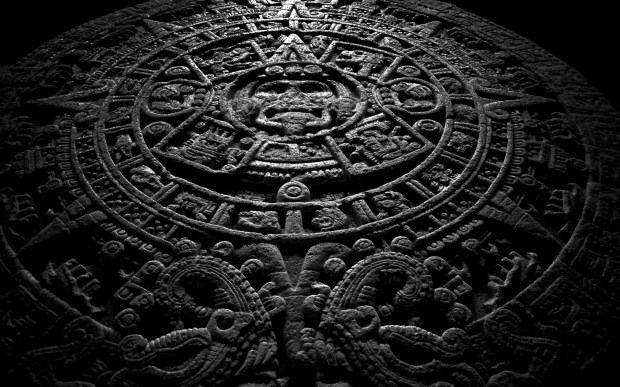
There’s a lot of controversy, fear, and conspiracy surrounding December 21st 2012. By now most people in the world have heard about it, yet very few people know what it is about. One widely circulated idea is that it will bring the apocalypse, or the end of the world in some way. There is much material out there arguing one side or the other, but few seem based on rational thought or analysis. I do not claim to know the answer as to what will happen on that future date, but I do want to lay down some facts and some of the theories, so that people can make their own informed opinion.
Source: The Mayans
The fascination in popular culture with the date of December 21st 2012 originates from the fact that
 this is the day in which the long count Mayan calendar ends. The long count Mayan calendar is composed of roughly 5,125 years, divided into 13 sections called b’ak’tun. One b’ak’tun is composed of 144,000 days, or 394.26 tropical years. According to Mayan myth as we can derive by what remains of the Popol Vuh texts, there have been three worlds prior to this one. Thrice the gods attempted to create the world, but failed. Each world lasted 5,125 years, or 13 b’ak’tuns. The fourth world was successfully created and humans were placed within it, and live within it now. The creation of the fourth world, when placed in the Gregorian calendar, sits at 3114 BC. This means that in 2012 Anno Domini we are now in the thirteenth and final b’ak’tun of the long count calendar of our age, signifying its end. There is no mention of catastrophic apocalypse that will occur at the end of the fourth world in Mayan text or myth, or none that we know of. Rather the idea of apocalypse stems from suspicion and the deduction that if every end of long count calendar has ended its world, so too must it end this one. In fact, the calendar is based on astronomical events rather than doomsday myth.
Astronomy
The date of December 21st 2012 was not only important to the Mayans, for it marks significant astronomical events.
First of all, the 21st of December marks the Winter Solstice in the Northern hemisphere, and the Summer Solstice in the Southern hemisphere. The solstice marks the point when the elliptic, the journey of the Sun in the sky as seen from the Earth, reaches its Southern
extremity marking the shortest day of the year in the North, and its Northern extremity and the longest day of the year in case of the South. December 21st has always been a significant date in the North, for it marks the conquest of light over darkness and the return of longer days. Traditionally it was celebrated as Sol Invictus (The Unvanquished Sun). The tradition was subsequently hijacked by Christianity to make the religion more appealing to pagans. Sol Invictus was used to mark the birth of Christ, and was erroneously placed on the 25th. So why is the 21st of this year special? It has in part to do with a phenomenon called the precession of the equinoxes.
Precession explained
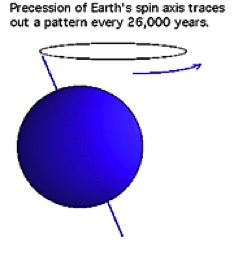
Precession is a slight clockwise wobble in the Earth’s axis as it rotates causing the stars in the sky to appear to move over long periods of time. The best way to visualize this would be to look at a spinning top. As it slows down and starts to wobble from side to side, it demonstrates the basic premise of precession. Precession causes the illusion that the Sun is moving backwards in the sky through the signs of the zodiac over the course of many years. This is measured in the West on the Spring Equinox, which marks equal length of day and night and the beginning of spring. On that day, the Sun also rises perfectly due East. The zodiac constellation seen in the East behind the Sun as it rose was thought by the ancients to have the honor of “housing the Sun”. However, they realized that this honor cycled through the zodiac signs. The Sun appeared to move backwards through the constellations. Meaning that in the night sky as we see the zodiac signs progress they would go in the order of:
Aquarius –> Pisces –> Aries –> Taurus –> Gemini –> Cancer…. And so on
But with precession the Sun moves backwards in the cycle. Where it once rose in Gemini on the spring equinox it then rose in:
Taurus –> Aries –> Pisces –> Aquarius
On the 21st of December, the Sun will be exiting the realm of Pisces, the Fish, to begin rising in Aquarius the Water Bearer, marking a significant astronomical event. It is significant because precession is extremely slow. It takes 72 years to shift one single degree in the sky, and it takes 25,920 years to complete 360 degrees, or one full cycle through all the signs of the zodiac. The Sun passes roughly 2,160 years in each constellation, or age. For the past 2,160 years we have been in the Age of Pisces, and beginning this year and for the next 2,160 years the Vernal (Spring) Equinoctial Sun will rise in Aquarius.
More details on precession here
Other astronomical alignments
In addition to the Solstice and the transition to Aquarius, the 21st will see a Galactic conjunction between the Sun, and the Dark Rift. The Dark Rift refers to a certain area in the sky that is populated by galactic dust clouds that block the naked eye’s vision of the stars. When one looks at the sky without light pollution, one can see a stretch of stars in a lane. That is the Milky Way. The Dark Rift dims or blocks the light from some of those stars. The most significant section of the Dark Rift stretches from the constellation Cygnus to Sagittarius.
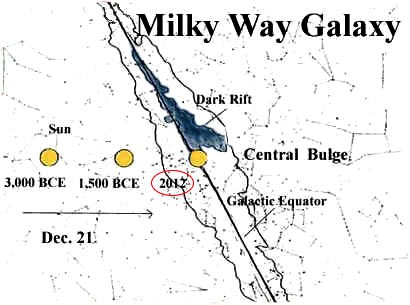
Some believe that the passage of the Sun through the Great Rift and the subsequent alignment with the core of the galaxy will have some sort of gravitational pull on our system, but this is not so. The galactic center is much too far from us to exert significant gravitational pull, and the event will be a conjunction and not an alignment meaning that the Sun will appear to pass through the Dark Rift as seen from Earth, but not from any other planet in our Solar system.
Interestingly enough, at dawn on the 21st the Milky Way as we can see it from Earth will lie on the horizon, touching it at all points around which some cultures and modern individuals refer to as the opening of the “sky-portal”.
So What?
Why does that matter? The occurrence of these celestial events makes up the empirical happenings of the 21st of December. It is clear that no stray asteroid or vortex will annihilate the Earth on that day, but that does not mean we should not pay attention to it.
The movements of the stars and the cycles of the celestial sphere are the only way Humans have to tell time. Without these celestial cycles it becomes nearly impossible to tell time, as any resident of a clock and window devoid home will tell you. If we consider the first two celestial cycles of the Earth’s rotation on itself and its rotation around the Sun as markers of time on small scales, the only way to identify specific points over large periods of time is to incorporate the third celestial cycle: precession. The only way to distinguish one season from the other is that the stars will move around in the night sky. Precession’s role as guardian of time then makes it a region of interest for any intelligent civilization.
It is a challenging thing to inform unborn generations about a certain period, especially in times of uncertain future because time sees languages die and documents vanish. However, one can assume that any advanced civilization will discover the precession of the stars. Our modern civilization knows about it, but we may not have been the first to discover it.
Interestingly enough, there exists on the Hoover Dam a star map of the sky as it stood on the day of President Roosevelt’s dedication on September 30th 1935. This is to help future astronomers set the construction of the impressive structure in time, should the knowledge of its construction be lost over time.
Claims that the Mayans were fools that just ran out of space to carve or stopped making calendars are ignorant and arrogant. The Mayans had a masterfully precise calendar system that took into account the movements of individual planets and eclipses. The origins of the calendar are uncertain; they are thought to have inherited it from the more mysterious and more ancient Olmec civilization. Whoever the authors of the Long Count Calendar were, they chose the Winter Solstice of our year as the end of the cycle based on these multiple conjunctions, and they were not the only ones to hold these events in high regard.
In 1989, a man named Robert Bauval put forward his Orion Correlation Theory, which claimed that the pyramids of the Giza plateau matched the stars in the belt of Orion, not as they stand now, but as they stood in 10,500BC. The discovery shook the world, and deepens the mystery of the 21st as we discover that many ancient civilizations held astronomy in high regard. It is in the mysterious land of Egypt that more clues to the December 21st puzzle can be found.
Ancient World
Egypt
Astronomy was prominent in Ancient Egypt, especially in mythology. The creation myth of Egypt speaks of the Sacred mound Nu rising out of the chaotic waters of Nun. Nu also marked the area where Atum, or Ra, (the Sun) first rose. Atum then proceeded to spit out his son Shu, god of the air, and to vomit his daughter Tefnut, goddess of moisture. Shu and Tefnut then give birth to Geb, the earth, and Nut, the sky, who would in turn give birth to the gods Osiris, Isis, Seth, and Nephthys.
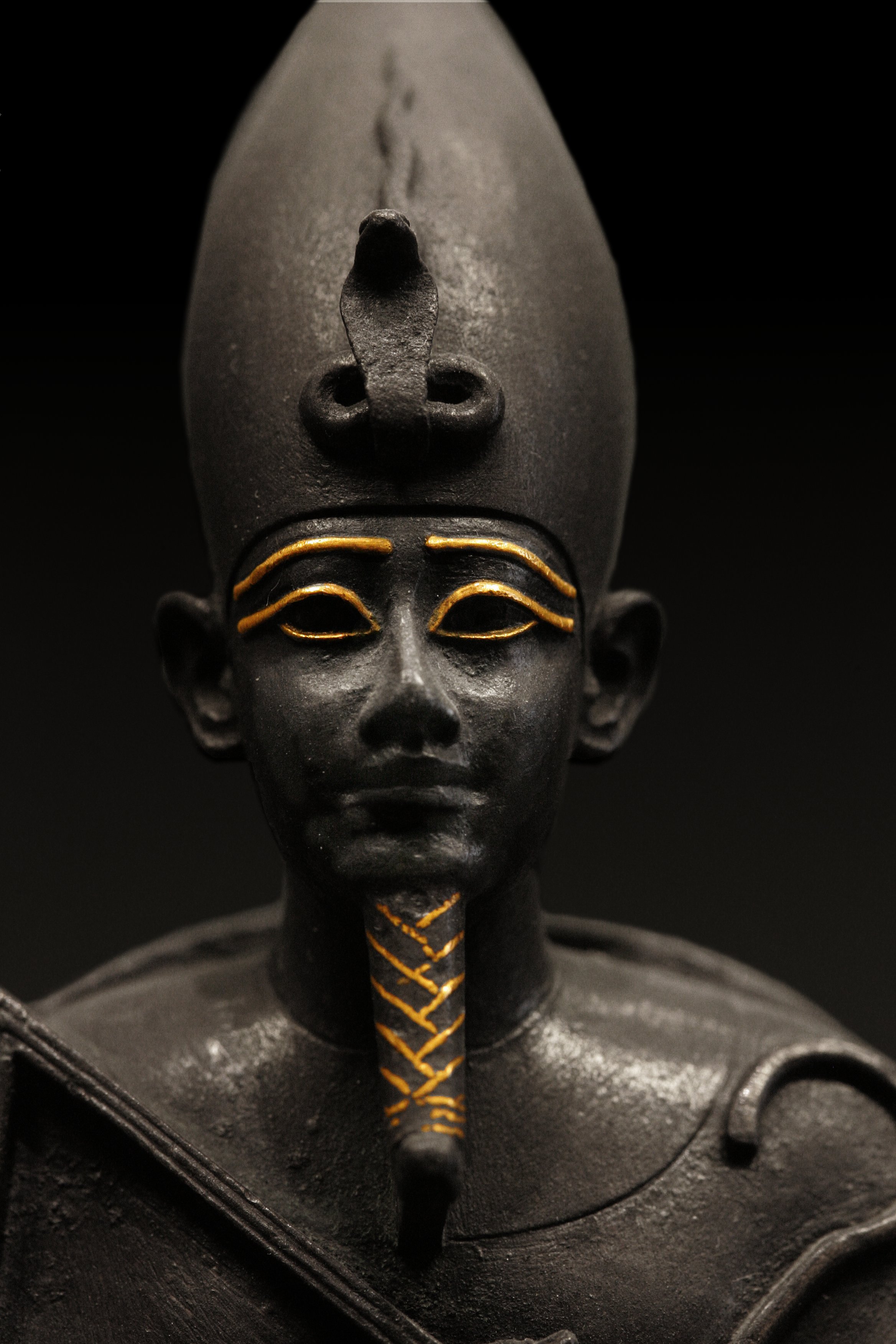
Statue of Osiris, King of the Dead
Osiris was a great king and said to have been a great civilizer. Under his reign Egypt was ushered into a prosperous era known as “Zep Tepi” or “First Time”. Osiris’ brother and enemy, Seth, plotted against Osiris and murdered him with the help of 72 conspirators. Isis, wife and sister of Osiris found his body, and Osiris ascended to the sky, as the constellation we now know as Orion, to become King of the Dead in the Duat.
The Egyptian afterlife or underworld was known as the Duat. The Duat was thought to be a place in the sky through which the soul traversed after death. It separated the land of the living form the land of the dead. The Duat was thought of having a precise location in the sky. As Graham Hancock writes in “Heaven’s Mirror”
“In fact the Duat had very specific celestial co-ordinates. …the Duat had been conceived of by the ancient Egyptians as having been “localized in the eastern part of the sky” …the oldest texts… tell us: “Orion has been enveloped by the Duat while he who lives on the Horizon purifies himself. …This is a true observation of nature, and it really appears as though the stars are swallowed up each morning by the increasing glow of the dawn.”
Evidently, this region of the sky was vastly important in Ancient Egyptian beliefs.
There are those who believe that the 72 conspirators who killed Osiris are a metaphor for the 72 years that bring about a one-degree shift in the precessional cycle, and that the 72 years and the subsequent movement of the stars represent a shift away from the “First Time”, and marking a decay of a golden age that came much before the First Dynasty of Egypt in the third millennium BC, and under which Egypt was said to be very prosperous.
Bauval’s correlation theory puts forth not only the idea that the pyramids mirror Orion, but that the whole Giza plateau is a depiction of this important region of sky. The Nile represents the Milky Way, and the three pyramids reflect the stars in the belt of Orion, not as they stand now, but as they stood in 10,500BC, potentially marking that point in time as the “First Time”.
This has controversial implications of course, because it sets the construction of the huge and complex pyramids earlier than the current estimated emergence of civilization, or at least marking a time before it. However, the pyramids are built stunningly close to perfect due North, South, East, and West and the presence of the Sphinx representing a Lion nearby combined with the prominence of that region of the sky in Egyptian mythology lends weight to the theory.
The Sphinx
The Sphinx is a half man half Lion statue, and has another controversial theory attached to it. John Anthony West discovered that the trenches that run along its sides were caused by water erosion. Water erosion caused by heavy rainfall, the type of rainfall that the now arid Giza stopped seeing in the late fourth and early third millennium BC. West stated that the Sphinx was older than thought, and estimated that it was built at least in the fifth or sixth millennium BC.
The Sphinx is built orienting perfectly due East. It gazes directly at the sunrise on the Vernal Equinox, this is so now and has been so since its construction. The only thing that changes is the stellar background of the sunrise. Speaking to precession’s time keeping use, in 10,500BC, the same era that the pyramids match Orion’ belt, the Sphinx would have gazed upon the constellation of Leo the Lion in the East as the Vernal Equinox Sun rose to bathe the ancient plateau in dawn light, and it did so until the end of the Age of Leo in 8,640BC. Leo was in the East then, and it is at the opposite end of the cycle now. In the Age of Aquarius Leo will be in the West on the equinox, not in the East.
Observation platform?
In Egyptian mythology the Dark Rift is held sacred and is known as the “Place of Purification”. It was regarded as being the place where creation occurred, and it was thought that
“the Sun on its journey along the ecliptic will enter a passageway, be purified in the Waters of theMilky Way and be reborn.”
Intriguingly, the best place to observe the coming conjunction, and its subsequent horizon-bisected Milky Way as well as the passage of the Sun though the Dark Rift is at Latitude 30 degrees North, the same latitude as Giza. This makes the Great pyramid, with its great height and clear desertic plateau surroundings one of the, if not the best, place in the world to observe these events.

Read more about the pyramids location and the mythology surrounding the conjunction here:
Whether the reader is convinced that the structures of the Giza plateau are older than thought or not is not what is important here. What we must mark is that astronomy played an important part in Ancient Egyptian life. Enough, it is believed, that they built monuments to the stars, and marked their motions. This will help to understand some of the theories surrounding the confusion of the 21st.
More references to precession and vast astronomical knowledge can be found in other areas of the world as well.
Cambodia
In the jungles of Cambodia lies another intriguing monument. Angkor Wat is a temple complex that full of astronomical and precessional references. There are a total of 72 temples on the grounds, same as the amount of years for a degree of precession. Furthermore, on the Spring Equinox the Sun aligns perfectly to the central tower of the main temple of the complex in a breath-taking spectacle of astronomical and architectural precision.
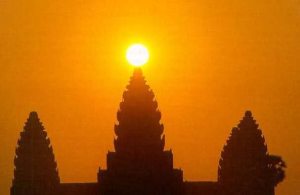
Angkor Wat’s precision at dawn on the Spring Equinox
Astoundingly, the temple complex was proven by Graham Hancock to reflect the stars of the complex constellation of Draco as they stood, like Giza, in 10,500BC. It is widely accepted that Angkor Wat was built in the 12th century, but archeological studies show that the temples were built on the foundations of previous ones which may have been built on even older ones, making the dating of the first constructions here an uncertain.
Prominent in the temple is the story of the churning of the milky ocean. In it, the forces of good and evil pull on the great snake Vasuki wrapped around Mount Madura, which “churns the milky ocean”. By this process, the gods and the demons hoped to create the elixir of immortality. The story and its wobbling of the world within the Milky Ocean can be reconciled with the principles of precession, and the Earth’s movements within the galaxy.
Most baffling of all is the fact that Angkor Wat lies exactly 72 degrees of longitude East of the Giza complex, the same number of conspirators against Osiris, the same number of temples at the site, and the number of years it takes for a one degree shift of precession.
Many passages in the Vedic texts also allude to precessional numbers. For example, the Rig Veda, the most ancient of the Indian Vedic texts, is made of 10,800 stanzas of 40 syllables. This brings the total of syllables in the text to 432,000. 108 and 4320 are significant numbers because it is the time required for a degree and a half progression in the formers case (72 + 36), and the duration of two eras (2 x 2,160) in the latters. Those numbers, with typically added increments of zeros are common in ancient myth and texts around the globe.
Myths
In 1969, Giorgio de Santilliana and Hertha von Dechend published a revolutionary book called Hamlet’s Mill. In it they investigate myths from around the world and demonstrate common themes of concealed astronomical knowledge. A panoply of global myths relate to some kind of divine millstone, which rotates around the pole star and grinds salt or something as such. The Churning of the Milky Ocean is one such example. Important numerology is also present, in Norse mythology, for example, there are 432,000 warriors that sally out form Valhalla to fight the Wolf Fernir in a tale that is full of reference to precession. This Norse myth alludes to Yggdrasil, the Tree of Life, which supports the Heavens and supports the mechanics of the stars much like the theoretical axel that traverses the Earth at the North and South Pole, and which circles causing precession. The two myths (among many) both demonstrate knowledge of the complex notion of precession and developed despite vast distance between the two.
For brevity’s sake, I will not go into detail of the various myths highlighted in the work, but should the reader be interested in finding out more Hamlet’s Mill encompasses all of them.
Judeo-Christian mythology is also curiously linked to precession. In the Old Testament, when Moses comes down form the mountain he finds the people worshipping a golden calf derived from Egyptian astrological Sun worship. Moses was said to have lived in the Age of Taurus which is represented by the calf. As the world moved into the Age of Aries its symbol, the Ram, suddenly becomes prominent in texts of that era. Abraham sacrifices a ram to God instead of his son Isaac, and the Shofar (a horn used for religious Judaic purposes) is quite often made with the horn of a ram.
Intriguingly, the Age of Pisces, the fish, corresponds approximately with the birth of Christ and the rise of Christianity, whose official symbol is that of the fish.
The many clues and hints at ancient knowledge of precession, as hinted at by the myths and legends of the ancient world, and by the stupendous monuments built aligned with stars and celestial motions like the pyramids, the Sphinx, and Angkor Wat adds weight and reverence to the theories surrounding December 21st 2012.
The hint of importance allocated to the movement of the stars makes 2012 intriguing in a unique way. Other doomsday predictions like Y2K or Rapture did not worry as many people because it did not have such a mysterious air about it. Most people can be scared just by the words “ancient Mayan prophecy”. These, combined with the multiple astronomical events that will occur on that day have led to theories on both extremes of the spectrum of optimism and pessimism as to what will occur.
Theories
Nibiru
Many positive and negative theories surround the 21st of this year. Among the negative one hears of Nibiru, or Planet X, an as of yet undetected planet or asteroid which is said will crash into the Earth and destroy life. Astronomers are quick to dismiss this theory however, as it is extremely unlikely that a planet could have remained hidden behind the Sun for the duration of mankind’s observation of the stars.

Chinese shelters for the apocalypse
Electro Magnetism
Less far on the apocalyptic scale, but still high up there, one hears of a pole shift.
This refers to a reversal of the magnetic north and south poles which could be brought on by a near collision course with Nibiru, or by gravitational or electro magnetic influence pulling on the Earth due to planetary conjunction such as the Sun conjoining with the Dark Rift. This theory holds more water than the Planet X one, for magnetic pole reversals are not only possible, they have happened hundreds of times in Earth’s history. By retrieving sediment cores from the oceans, scientist have been able to determine that pole shifts happen about every 200,000 to 300,000 years, but it has been more than double that time since the last one, leading some to believe we are overdue. Others believe that the important terrestrial electro magnetic field, which protects us from solar radiation, might disappear or be weakened by the conjunctions or by increased solar activity. Furthermore, the poles have been increasing in movement of late, and the field’s strength has weakened by 10% in the last 150 years lending scientific plausibility to these theories.
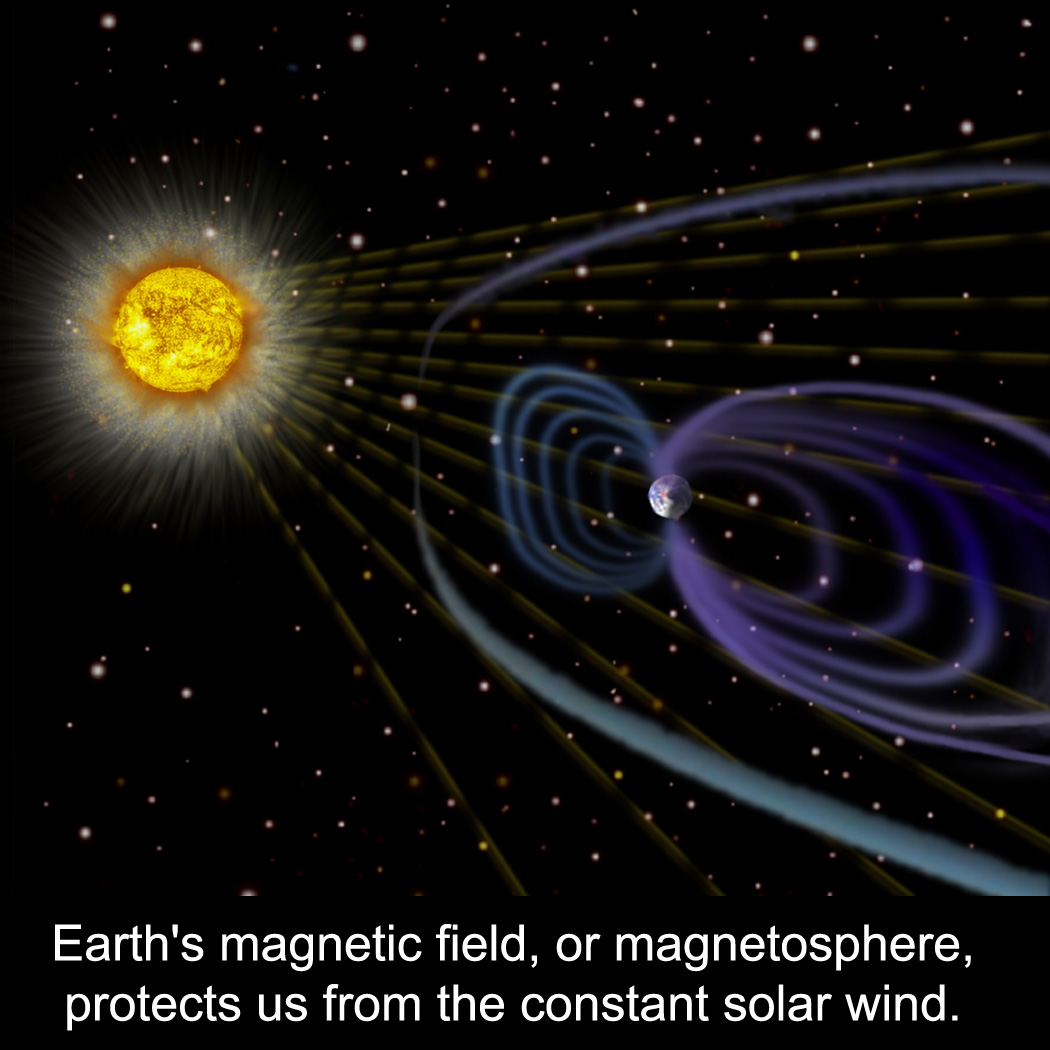
Lastly, in the Electro Magnetic vein some believe that Solar flares could hit the Earth and ravage humanity’s electrical grid essentially sending us back to the Dark Ages. A devastating electromagnetic pulse from the Sun has hit the Earth before, it was called the Carrington event. It occurred in 1859, so technology was not widespread but telegraphs threw sparks, started fires, and shocked operators. The Northern Lights could be seen across the world. A strong storm like that could ravage today’s electricity addicted world, and we are not ready to deal with it. Only recently has the US government started to listen to experts and begin to draft contingency plans against such an event. The potential effects of instantaneous loss of power were explored and popularized on television with the new series “Revolution”, making the theory’s hold on the public mind apparent.
General social conditions
Others yet cite Human folly as the bringer of apocalypse instead of divine fury. Their point is not far fetched for the world is in global crisis with a spiraling economy, suffering ecology, and political tension between vast nations who have bombs capable of annihilating the Earth. The theory is encouraged by the recent turmoil, and the world’s government’s inaction to solving environmental and financial problems.
Not all doomsday theories are based on fantasy, and some remind us that we could blow ourselves up anytime, and that our planet is subject to astronomical whim. Scary stuff. However, such theories for the most part do not account for the importance of precession on that day and in antiquity, and they tend to be blown out of proportion by popular media causing panic in segments of the population, and slandering theories that otherwise have some scientific basis. On the brighter side, there are various groups and theories, which offer a different view on the events to come which are more inspiring and optimistic in nature.
Positive
The Modern Maya
What of the Mayans? The general public is happy enough to listen to ancient supposed doom prophecies from the Mayans, yet it ignores the words of the modern Mayans. The Maya of modern times say what is repeated though the positive theories: it marks the end of a cycle, and the beginning of another. They believe that the 21st marks not the exact date, but a general point in time around which a shift will occur. They believe that their way of life will be remembered and that people will go back to living in harmony with nature with respect for life in their hearts.

Though ignored in our Western cultures, the message of the contemporary Maya is one that has its advocates, even on the international stage. The president of Bolivia declared at the UN:
For more information on the thoughts of the Maya, I recommend the reader watch this documentary:
Cyclical Consciousness
One of the more far-fetched but quite interesting positive ideas I’ve read about involves a cycling of Human consciousness levels by celestial influence. It argues that the celestial cycles have great influence on life. Day and night moves humans and animals from wakefulness to subconscious sleep, and the seasons cause organisms to sprout from the ground, bloom, and die, or causes mass migrations or mating in animals. The idea is that the third celestial cycle of precession might have an equally great effect on life, but it is too slow for us to notice. Like the may fly, who lives only day and has no idea about seasons, humans live on average one precessional degree or less, and have no idea of the cyclical effects. The idea also ties to electro magnetism, for as Dr. Valerie Hunt of UCLA noted subtle changes in the EM field, which can be brought on by celestial movements, can drastically affect Human cognition.
The idea put forward by Walter Cruttenden in Lost Star of Myth And Time is that Humanity passes through stages of consciousness based on the precessional cycle. The Vedic texts name the rising phases of Kali, Dwapara, Treta, and Satya yugas before declining again in the inverse. The Greeks simply called them Iron, Bronze, Silver, and Golden ages. According to this theory, the “suns” or “worlds” of the Maya as described earlier also refer to cycles of consciousness. Furthermore, the theory states that we are at the opposite end of the cycle of the Golden age, the lowest point of consciousness being in 500AD. This means that the last Golden Age was around 12,500 BC (the book sets the cycle at 24,000 years instead of 25,920 years) and that the next will occur in 12,500 AD. The coming Age of Aquarius, then, marks the first change away from the low point or Iron Age. According to this theory we have been in the ascent for already 1500 years, but have yet to transfer into a new Age to distance ourselves more clearly from the low point.
This is an interesting idea to toy with. If one looks at 500 AD, at a glance at least, it is chaotic. The mighty powers and centers of learning of Ancient Egypt, Classical Greece, and Rome have all fallen to ruin and the West entering the Dark Ages. Ideas are suppressed, and war, poverty, and fear is widespread. It would be another thousand years before the Renaissance brought back the ancient ideas to the Western world. Of course, on the other hand not every area of the world fared so poorly. Baghdad thrived as a cultural jewel of knowledge and trade and Islamic kingdoms were powerful and wise.
Even then, one cannot deny that our world since then and perhaps before is almost spiritually dead. We have religions, but they have strayed so far from their original values as to become institutions of power. It was common practice in the past 2000 years to burn and otherwise suppress anything or anyone who professed different ideas than the dominating ones, and in Modern times profit is valued above everything else even if it means widespread ecological destruction or exploitation of fellow Humans.
Even more interesting is that the date for the last Golden age roughly coincides with the point in time immortalized by the Egyptians at Giza. Could the constructions have been built to try and immortalize the time when the Egyptians noticed the decline of the Golden Age? Nothing is impossible.
Some, like Paramahansa Yogananda, author of Autobiography of a Yogi, go as far as to say that by 4100AD when we enter the Treta Yuga (or Silver Age)
“telepathy and clairvoyance will once again be common knowledge.”
Citing the Tower of Babel story from Genesis around 3100BC as being in the last Treta Yuga when mankind communed freely with nature and itself before God “confused the tongues.”
New Age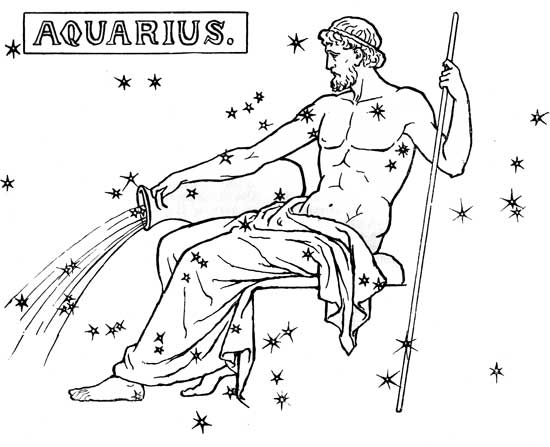
The New Age movement bases itself on roughly the same ideas as those above. It is a movement that combines science and open spirituality not advocating for any single religion. The name derives from one of the core beliefs of the movement: that the Age of Aquarius will bring a New Age for mankind.
Although the ideas of Walter Cruttenden would technically fall under New Age ideology, not all of it is as radical. Proponents of the movement simply believe that the New Age will bring a spiritual rebirth to Humanity and help bring peace and order to the world. That in this New Age people will re learn to live in harmony with nature, that we will solve our differences in peace, and that equality and fraternity will be the law of the land.
New Age believers do not necessarily believe that dormant telepathic powers will awaken and bring them to peace. Rather one needs only to look at technology and the current trends to get the idea. Was there ever a pacifism movement prior to the 1960s? If so it was small or was suppressed in history. There is a growing counter culture which advocates equality and fraternity as evidenced by the recent Arab Spring and the Occupy movement. Our technology, the Internet in particular, is allowing mankind to connect globally like never before (in recorded history anyway). One need only look at the recent Palestine Israel spat, where global outrage led to a rapid end in aggression and the avoidance of a ground invasion. A thousand years ago citizens only had the word of officials or rumors to know what was happening in the world. Enemies were painted as monsters and heathens and allies as heroes no matter what atrocities were committed. Had this short conflict occurred even just 200 years ago Israel could have done as it wished without having to answer to the world.
This is a fascinating idea, and this is the theory I personally subscribe to, and it is the inspiration behind the name of this blog. When people come together they can accomplish great things and it is now easier and easier to connect with people globally. The Internet also allows individuals to access the collective knowledge of mankind from almost anywhere instantaneously marking a far cry indeed from the ages of ideological control and repression. I personally believe good things are just over Humanity’s horizon, and it is up to us to us to bring them about. If we do not bring about change, then climate change will wipe us out if we don’t blow ourselves up first.
If enough people expect change to occur, then it will. This is one of the problems brought on by the fear mongering of doomsday. If people simply fear the day and then scoff when thinking back on it as a bunch of rubbish then the modern Mayan and New Age message is lost.
“The are more things in Heaven and Earth than is dreamt of in your philosophy”
It is important to realize that the date of 21st of December 2012 is an important one in more than one culture because it allows clarity. They do not claim mass destruction, but it would be foolish to disregard the date as insignificant.
Conclusion
No matter what happens on the 21st it marks an important time in Humanity. On that day, almost every person on Earth will be thinking about the same thing, about this event and the potential end of the world. Not only is the species’ collective mind rarely focused on a single event, it is even more rare that it focuses on existential questions. We bustle about in our daily lives offering little time for the most part to the great questions of existence like what is our place in the cosmos, and the question of death. Though fear might be a negative thing, the fear surrounding the 21st helps to remind us that our existence, individual and as a species, is very fragile and at its core but a temporary thing.
Regardless the belief you hold, I invite you to take the 21st seriously and use it to meditate on life and our direction, as individuals and as a species. Live as if the world was ending that day. Do what you want, tell people you love them, there is nothing to lose in living as it were the last days, as long as you do not harm others.
I also encourage you to not cower in fear, only to scoff at the foolishness of the Maya as the day passes. If the world does explode, then crouching in your basement won’t save you, and you will miss something that only a very small selection of humans, those living in 2012, will get the chance to see. If we go through a spiritual consciousness shift, then fear will assure that you are blocked from the effects. Do something fun, go somewhere interesting, look at the stars, go with your loved ones, and think about it. Life is short, fragile and precious, and this is the Mayans’ and the cosmos’ way of reminding of us of that fact. I will see you all on the other side, which ever side that may be.
Further reading for the interested:
Mayan Cosmogenisis, Overview of Walter Cruttenden’s A Lost Star Of Myth And Time, Electro Magnetic reversals by NASA, Churning of the Milky Ocean
 Julien Dupont