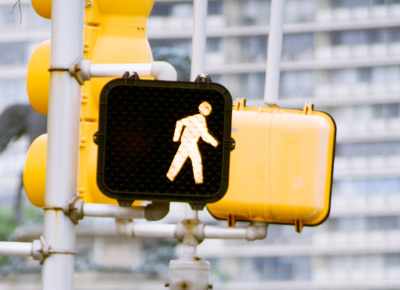
Being immersed in our respective culture and societal patterns makes us so used to their presence that we do not detect them anymore. Culture shock is a common feeling for travellers, who, when visiting diverse areas in the world, are launched out of their culture into a foreign one. Homesickness is a real psychological occurence, and stems from the desire to return to one’s own presumably logical and proper way of life. Such culture shocks allow one to see how much is taken for granted as standard back home, how much is made up and simply imposed on him or her from a lifetime exposure, and just how powerful it can be.
Prime examples for this go unnoticed everyday in routines of life. In the great downtowns of the West, pedestrians dutifully rush from one store or work place to another, crossing the road in a hive of activity all under the safe gaze of the little white “walk” man. We trust it more to inform our decision than we do our own instinctual assessment of the situation. People, myself included, will begin to walk across the street as soon as the little man comes up, even if there are cars are still approaching rapidly, sometimes with little room for smooth deceleration, the spot we are engaging ourselves into . These multi ton metal machines speeding towards us definitely have the potential to harm us, and should alarm one enough to not get in a collision course with such a fierce opponent. Yet most people cross without even a glance at the oncoming traffic, they have a complete and utter faith that the Little White Man will protect them, and that the red bulb the driver sees will be enough to make him stop. In fact, the Little White Man embodies the same kind of minor deities of safe travel who’s worship was not uncommon before Christianity. The worshippers gaze at his luminous altar intently devoting mental energy in prayer-like fashion waiting for him to appear, and crowds move according to his blessing.
Conversely, we have associate the little red “stop” hand with danger, and forbidden passage, sometimes regardless of if the road is busy or empty. People will stand alone on the corner waiting for the go ahead sign even if no cars are in sight, convinced that this is not the proper or safest time to cross. It becomes most bizarre to see people act this way when in fact all basic instinct and common sense would indicate that this is the safest time to cross; with no cars incoming,
Our society effectively encourages us to abandon some our survival instinct and to put faith in the system. The faith is not necessarily misplaced; society does a pretty good job at making drivers stop for red too, and pedestrian accidents aren’t that common. But it only takes one instinctually-easy to avoid accident to send someone crashing to the Earth, potentially falling as much as six feet deep.
It is a startling thing to realize that our societal life conditioning is so powerful as to alter our threat assessment and to override the primal instinct which has allowed our ancestors to survive, and which would oppose approaching something like a moving car. Anyone experiencing out culture without being versed in its ways, like someone from a thousand years in the past for example, would surely fearfully refuse to step in the road while these moving blocks of metal are decelerating, but still approaching at great speed regardless of the Little White Man’s assurances. However, for us modern and civilized North Americans waiting three seconds to see if the cars are all stopped is frivolous and an unacceptable delay. Time is money after all, so they say.
 Julien Dupont
One comment