** Hey all, I turned this school paper half into a blog post, and I thought I’d share it. Enjoy!
—————————————————————————————————
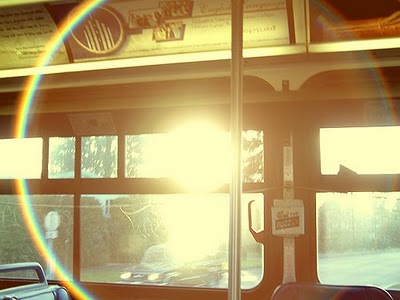
He appeared, a little bit out of nowhere. My eyes opened in a start behind my sunglasses as Bob Dylan’s guitar and harmonica suddenly began to play on my shuffled music. I was on a crowded bus, and before me stood a young man. He was tall. His long brown hair was cleared from his grey eyes, and fell onto the brown jacket he wore over his checkered patterned dress shirt. He looked nonchalantly studious, or studiously laid back, I couldn’t tell which. He seemed a bit clumsy, and a bit goofy. The coincidental combination of this odd looking man, and of the corny up beat Bob Dylan guitar and harmonica made me chuckle. Not meanly, but the song just seemed to fit his personality perfectly.
As I smiled to myself, the bus opened its doors, and a new verse in the song begun. Entering into our midst was a young girl with short brown hair pushed back by a headband; glasses on her almost mouse like face. Her brown coat, little red mittens, and the way she held her bag made her cute in a geeky, and sort of clumsy way. It struck me right away that she fit the music perfectly too, and the tall gentleman knew it as well. She stood next to him; they looked at each other for a second, and looked away.
Well, I got up and walked around
And up and down the lonesome town.
I stood a-wondering which way to go,….
Dylan sang. I was becoming quite amused now; the musical air matched this scene peculiarly well. Talk about synchronicity! I felt like I was in a movie. I wanted the guy to try his luck; I saw him think about it, saw him run his eyes up and down her, but very quickly then look away, and I saw her steal quick glances over her shoulder. The gentleman hesitated. Yet the fates had not finished their game yet. More people came onto the bus; the lady was forced to move further down the aisle, and now she held onto the same post as the musical’s protagonist. They looked away. I almost wanted to somehow cause an icebreaker, but decided to maintain the role of the observer to this glimpse into human existence. Dylan rambled on in his “Talking World War III Blues”, with another verse:
Down at the corner by a hot-dog stand
I seen a man, I said, “Howdy friend,
I guess there’s just us two.”
He screamed a bit and away he flew.
Thought I was a Communist.
A new stop, and two seats next to them opened, surely now they had no choice but to sit together. Our waiting lady assumes her seat while the gentleman offers his to a nearby standing woman, like gentlemen do. The dame refuses, but still he does not sit. The female lead has even started knitting, an easy opener for conversation. At a glance, the situation and its characters reflected the apparent of goofiness of the song. However, if one listens closely, the lyrics of “Talking World War III Blues” contain much more depth than first perceived by the joyful air.
I was feelin’ kinda lonesome and blue,
I needed somebody to talk to.
So I called up the operator of time
Just to hear a voice of some kind.
“When you hear the beep
It will be three o’clock,”
She said that for over an hour
And I hung up.
So too for this situation, did a longer gaze cast aside the apparent goofiness to reflect a deeper and darker truth. More people came on. The open seat was quickly usurped by a woman, and separated was the estranged couple. We slow again, I look to my right distractedly, and then look back to my left, and the protagonist is gone, presumably disembarked. The lady exits though the right hand door a few stops later.
“I’ll let you be in my dreams if I can be in yours,”
I said that.
Were the powerful closing lyrics held in my mind as Dylan’s final chords rang out. Had my shuffled music followed with The Beatles’ “Eleanor Rigby” I would have fallen to my knees in awestruck worship of the shuffle gods right there, in the middle of the bus. Where do all these lonely people come from? That didn’t happen, so my mind was left free from religious musical fervor to ponder on what I had seen.
I thought about my previous post about the negative nature of society and icebreakers, and about the absence of the kind of love found in other points in space and time. This decade resembles the 1960s more than any other. Parallels can be drawn whether you look at social issues, values, politics, the changing music industry, etc… More precisely, our time reflects the early 1960s, which precluded the more famous moments of the decade, and the feeling of love and solidarity that characterized its social movements.
Parallel Worlds
“The Freewheelin’ Bob Dylan” was released in 1963. It was upcoming Robert’s first popular album and was politically charged. On it we find powerful songs like “Masters of War”, “A Hard Rain’s a-Gonna Fall”, and of course “Talking World War III Blues”. The release came less than a year after the Cuban Missile Crisis at the height of Cold War tensions. Only a few months after the release, John F. Kennedy was assassinated, President Lyndon Johnson sworn into office, and the Vietnam War started in earnest. These troubling events acted as catalysts for the peace movement that would then spring up all over America. The world was starring MAD (Mutually Assured Destruction) in the face, fear of enemies was rampant, and the movements that would later characterize the decade such as the Civil Rights Movement and the Hippie movement had not yet grown to the prominence we now remember.
It is supposed that the WW3 that Dylan refers to was in his mind a warming of the Cold War to a nuclear hot one, not a reference to a far off futuristic one. The issues outlined in “The Freewehelin’ Bob Dylan” reflected the social circumstances of its time, yet it also applies to our times strangely well, indicating that today’s political and social climate has either not changed since or has returned to something like that of the early 1960s.
Loneliness, like that described in the verses of “Talking World War III Blues”, is rampant in contemporary Western Society. Although no one calls the archaic “operator of time” anymore, technology has no less replaced human contact. A key detail of the bus scene was that neither character had earphones on, or a screen to steal their gaze. All the people around them, including me, had at least of their senses blocked by some devices or other. Oh what cruel irony that leads people to text and surf the web for social interaction, to fill that need for human contact, while all around them are other humans, most likely lonely as well. How many locked eyes and conversations marking the birth of friendship or love have been stolen by an incoming text message or song? It played into the beauty of the moment that both characters saw each other, and were open to each other not closed in some personal bubble. A rare sight indeed.
However, technology is not the only problem to human social contact. The other obstacle again accurately described by Dylan over 50 years ago is fear.
He screamed a bit and flew away,
thought I was a Communist.
People are too afraid of other people. There is a negative aura about strangers that is drilled into our minds by the same kind of Commie fearing media that 1960s inhabitants experienced. 50 years later, Terrorist-fearing media tells us of men suicide bombing and chopping up people on buses, rogue nations stockpiling nukes, or of deadly diseases and storms ravaging the world. A sad confirmation of the reign of fear was the scene I witnessed, and it is in fear that people give up liberty and peace for paradoxical security and war.
Today, it is not uncommon to hear people talk of a new World War. Radical political parties are gaining popularity in Europe as the Union is met with riots and protests over much of the Mediterranean. Tension is growing in the Pacific Ocean as China rises to power, the Middle East is in a chaotic mess, and the East and the West seem to constantly be butting heads on the world stage about issues like Iran, and Syria to name the newest. There are wars in the region, that have now been exposed to be started on fabricated lies. The defense budget of the United States in 2012 was 695.7 billion dollars, more than the next 9 largest defense budgets combined. This expenditure comes at a time of no major war, but rather at a time of global economic collapse, and abysmal American health and education records. Again Dylan echoes our thoughts with “Master of War”:
You fasten all the triggers
For the others to fire
Then you sit back and watch
When the death count gets higher
You hide in your mansion’
As young people’s blood
Flows out of their bodies
And is buried in the mud.
This would not be out of place in a poem written by the now famous “99%” about the “1%” of today. The ruling class might not be as ideology driven as the sixties. Instead it has a new unique goal in mind: profit. Profit is what we seek in wars, it drives the ruthless destruction of the environment and social programs, and profit-making skills are essential to get into a position of power. Worst of all, like the atomic families of the late 1950s, today’s population is blissfully ignorant and/or apathetic of the state of affairs, nearly to the point of satire. A bigger house is happiness, celebrities the new messiahs, and politics is a thought that occurs once every four years when the time comes to put an X in a box next to the name that you heard before.
Parallels between our two eras can be drawn endlessly. We can look at music, which in the 1950s was very manufactured and polished, and which in the 1960s exploded into many new directions under the guidance of small labels, and independent creativity. In fact, Bob Dylan was among the first to popularize rejecting manufactured songs to write your own. Though many view today’s music as mindless and talentless there is a growing underground “indie” movement that never ceases to deliver new and inspiring content, and with the help of the Internet it is poised to take over the dominant labels in prominence. The drug culture is making a come back as well. After rapidly gaining a central role in the 1960s counter culture, it was faced with propaganda and repression from the government, which impacted drugs negatively in the public eye, until today. One need only look at the growing medical marijuana and hemp industries, or to the recent groundbreaking legalization laws passed in Colorado and Washington.
Hardly anyone with a clear view of the view of the global situation in the days of Dylan would have described it as good. High profile assassinations and conflicts, both abroad and at home, were exploding, and no one knew whether tomorrow would see life or a nuclear wasteland. Bob Dylan expressed what many of the coming generation felt, that there was much wrong with the world. In turn the disenchanted found their voice, which expressed itself in new music, values, and social movements to try and influence the uncertain future. People were tired of living in constant fear of destruction.
The world now stands on a familiar precipice. Our current global situation cannot be described as good by anyone with a basic understanding of the issues. Hopeless is not the word, it never is. Dangerous uncertainty does more justice. We face the same issues as the 1960s, but under different masks. The Middle East is our Vietnam style proxy war, corruption and greed our ideological opponent, and the Environmental movement and the Occupy movement and its offshoots are our contemporary Hippie, Woman and Civil Rights movements.
Now To Then
Would the world be saved had the two characters on the bus met? Probably not. Is the world doomed now that the chance has passed and they did not? Probably not. However, no popular movement of solidarity that sought to improve the lot of humanity, or to influence its course, ever originated from quiet, fear-filled solitude. What people need to ask others and themselves, and if history is any indication, will be asking in the streets in the coming years is: “Do we need to live like this?” Do we need this fear, hatred, pollution, and war? Bob Dylan did not think so. I encourage anyone who has not yet heard Bob Dylan or his Freewheelin’ to go out (or stay sitting) and get the album, and more importantly to reflect on the messages in the music and on humanity’s current situation and direction.
Bob Dylan was a man fit for his time. Little did he know, or hope I suppose, that his words would still ring eerily true for today’s problems. His foresight bestows on him the name of visionary to add to his lyrical genius title. However, I suspect that he would rather have slipped into anonymity in a changed world than maintain fame as one of the few truth speakers in a continually fearful broken one. Maybe if no one knew who Bob Dylan was anymore, there would have been two less lonely people on the bus today, and maybe Eleanor Rigby wouldn’t be so impressive anymore.
Being a Music Industry Arts student, I often get asked: “What decade do you wish you lived in?” Music wise I used to say 1960s or 1970s for the sheer musical talent and innovation; otherwise I’d say any other century because I thought our time was boring compared with history. I was wrong. When people ask me today I tell them I choose to live now. It’s when we are, and it’s an exciting time. The future of humanity certainly looks uncertain right now. Will we build bombs too powerful? Will we stop global warming in time? Will profit triumph over people? Will we be lonely individ
From David X Zhang (http://www.flickr.com/people/zhax/)
uals in the bus, or will we be a caring collective in a better world? We are the generations that get to decide that, and hopefully none of the issues I write about now will matter in 50 years.
 Julien Dupont